Academic case study A02
PATH
An AI chatbot that helps students choose their university path with the Designing Your Life method
- Period
- 2022–2024 — MSc coursework
- Context
- Academic concept for the University of Siena's orientation service
- Role
- Co-creator and designer: concept, user research, conversation design, Wizard-of-Oz prototype
- Programme
- MSc coursework — Digital Communication / Communication Design / Cognitive Sciences
- Team
- Two-designer team
- 15,3%
- of Italian graduates struggle to choose a path
- 6,6%
- drop out in the first university year
- 24/7
- free guidance, on the university site
Problem
- 15,3%
- of graduates struggle choosing their university path
- 6,6%
- first-year dropout rate, plus 8,7% switching course or university
- ~40%
- after the final exam still undecided between university and work
Source: Rapporto Almalaurea 2020
Source: Rapporto Almalaurea 2020
Source: Rapporto Ansa 2018
Choosing what comes after high school is a decision most students face with little structured support. Traditional orientation is episodic — an open day, a brochure — while the uncertainty is continuous.
Target user
Andrea
19 — recent graduate
- Profile
- Uncertain about which faculty fits him; browses the university site without a clear direction.
- Goal
- Understand which degree course matches his aspirations.
Corinna
24 — student in crisis
- Profile
- Considering dropping out of her current studies.
- Goal
- Figure out whether to change route before abandoning altogether.
Francesco
34 — professional
- Profile
- Works, but wants to specialize further.
- Goal
- Find the right course to grow in his field.
Marianna
25 — evaluating options
- Profile
- Weighing different scenarios for her next step.
- Goal
- Compare the possible versions of her future self.
My role
I co-created PATH in a two-designer team: from the benchmark of the department's existing TutorBot to persona and journey mapping, the storyboard, the question-tree dataset, and the Wizard-of-Oz testing sessions.
Process
The core idea: embed Bill Burnett and Dave Evans' “Designing Your Life” framework into a conversational agent. The chatbot guides students through reframing — imagining three possible versions of themselves — before matching aspirations to actual courses and career paths. We benchmarked the DISPOC TutorBot, whose dataset covered a single department, to design a cross-department, always-available alternative.
01 · Trigger
- Actions
- Fresh out of high school and uncertain, Andrea finds the PATH icon on the university site and reads the welcome message.
- ▾ Pain point
- At first glance the PATH icon may not make clear what it refers to.
02 · Phase 1
- Actions
- He starts chatting; the first questions aim to understand his situation.
- ▾ Pain point
- Initial distrust — the user may tire of preliminary questions.
- ▸ Opportunity
- A friendly, neutral tone keeps the user from walking away this early.
03 · Phase 2
- Actions
- As the chatbot requests, he imagines three possible versions of himself and describes them in chat.
- ▾ Pain point
- The unconventional approach (Burnett's model) takes time and trust.
- ▸ Opportunity
- Pair the request with a short explanation of the method behind it.
04 · Phase 3
- Actions
- PATH returns a map of alternatives and advice on approaching each profession.
05 · Goal
- Actions
- Andrea finds a fitting degree course — in another city — and thanks to PATH doesn't waste time evaluating it.
- ▸ Opportunity
- Deploy PATH across all Italian university sites, linked to share course data.
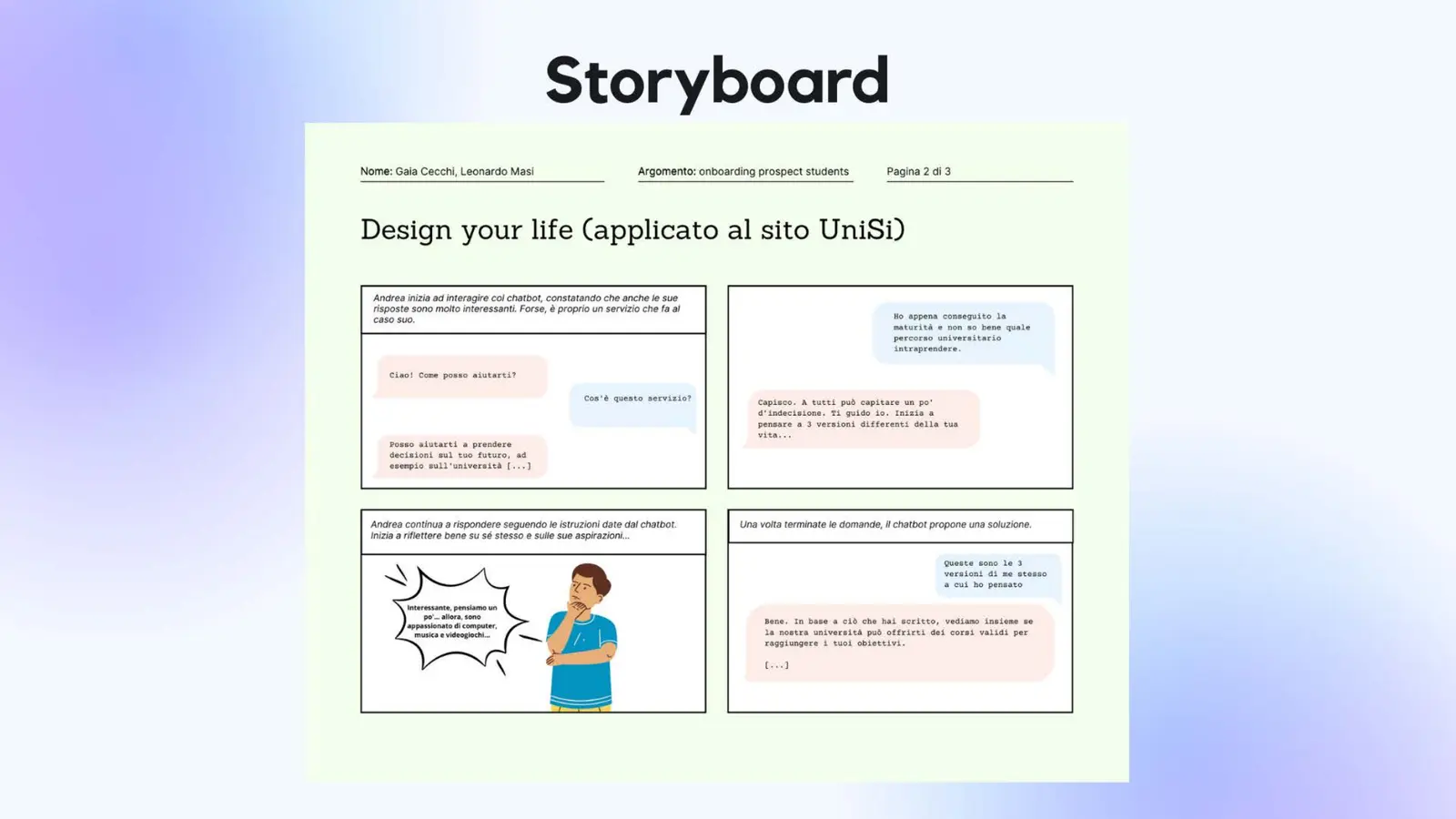
Key decisions
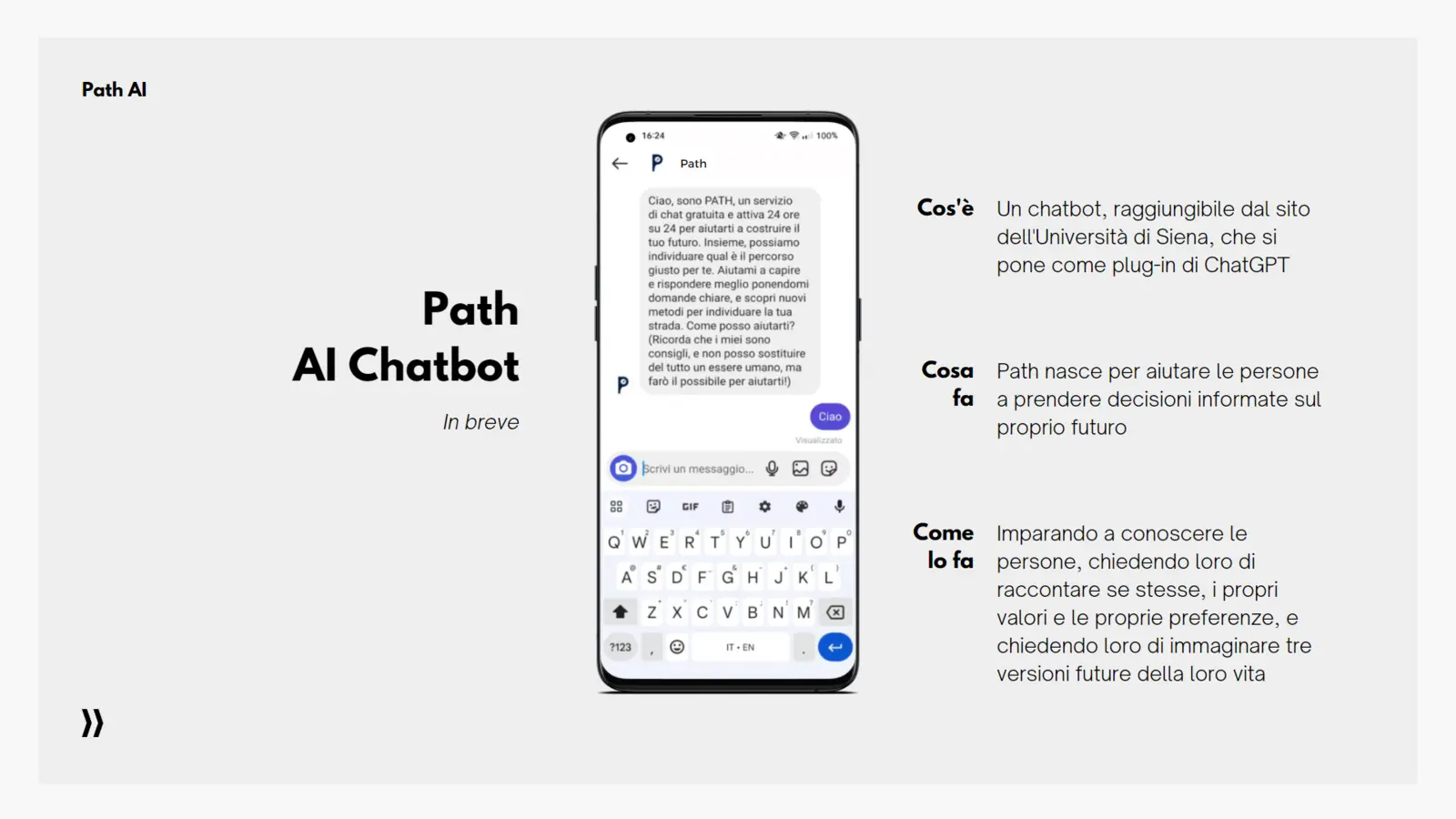
- Position PATH as a ChatGPT-based plug-in embedded in the university site, not a separate app to install.
- Friendly, neutral conversation style — guidance without judgment, so undecided users aren't pushed away.
- Explicitly explain the Burnett method in-chat: unconventional models need transparency to earn trust.
- Structure the dataset as a question tree (ALGHO platform) spanning courses and career outcomes across departments.
Final result
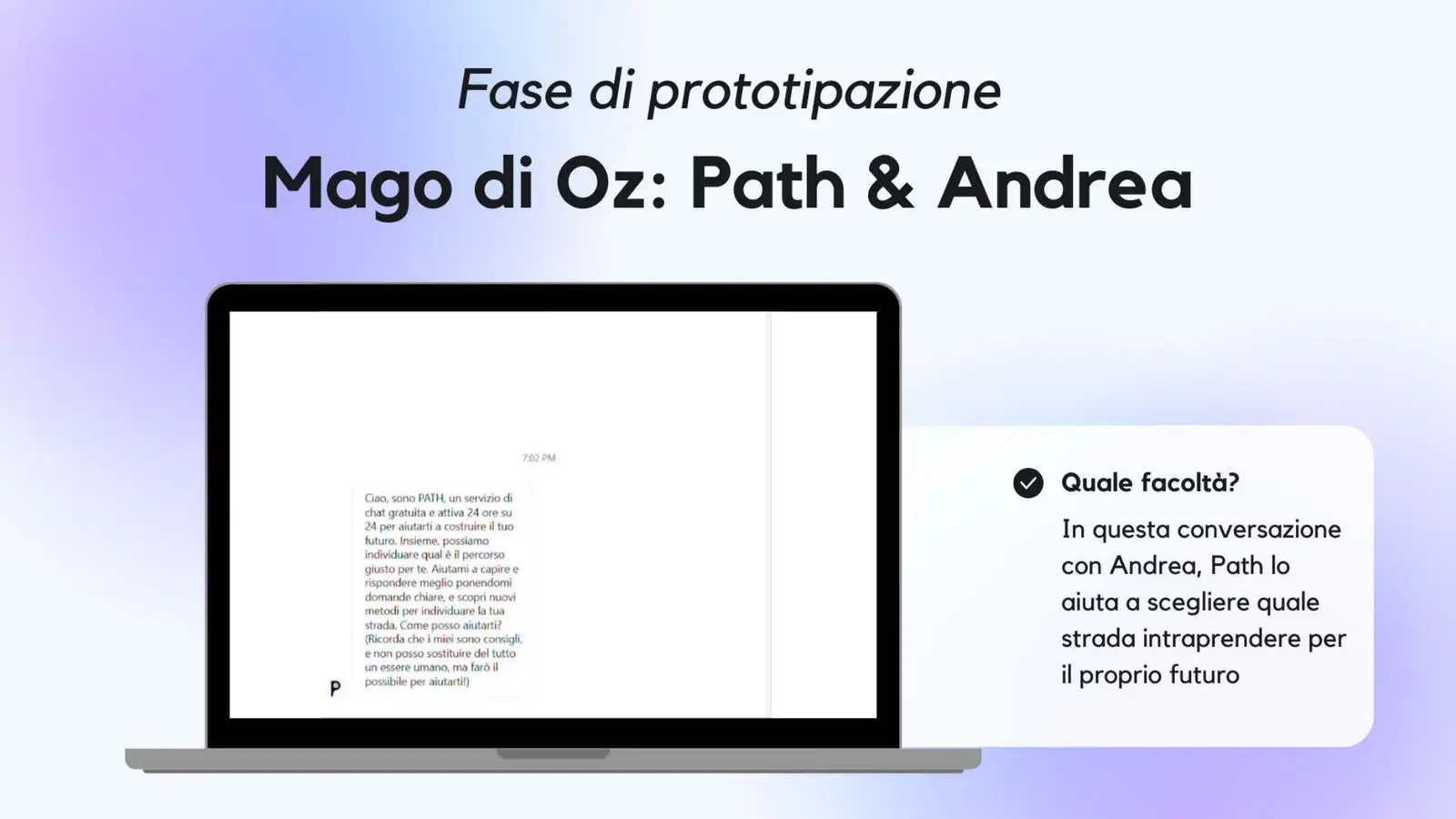
We validated the conversation design with a Wizard-of-Oz prototype — real dialogues with users playing out the personas' scenarios — plus a Balsamiq wireframe showing PATH embedded in the UniSi site.
What I learned
- In conversational products, tone is architecture: a friendly, neutral style is what keeps uncertain users in the funnel.
- Unconventional methods must be explained, not just applied — users grant trust when they understand the model working on them.